头文字d
无雪的季节,吉林这些滑雪场在“反向保温”_我的网站

A |
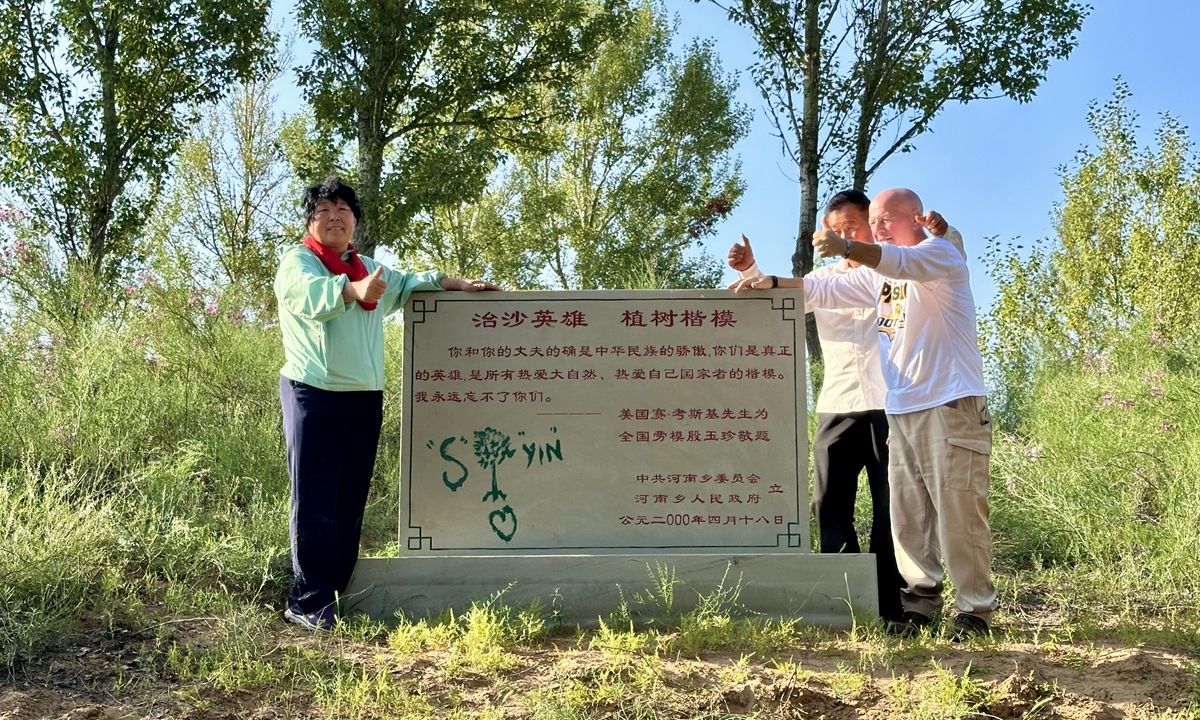
At the Ordos Ejin Horo International Airport in Ordos, North China’s Inner Mongolia Autonomous Region, Yin Yuzhen, a nationally recognized hero in desertification prevention and control and her US friend “Sai Kaosi” (whose real name is Ronald Sakolsky) embraced each other in tears.
This reunion after 26 years, spanning the Pacific Ocean, took place as scheduled under the witness of the lush greenery of the Maowusu Desert, touching the hearts of countless people around the world.
This reunion across mountains and seas was not only a long-awaited gathering of two old friends, but also a vivid testament to how goodwill can take root, how people can work together in desertification control, and how people to people friendship can endure.
This reunion was a beautiful echo of goodwill transcending time.
Twenty-seven years ago, Sakolsky, who was teaching in China, was deeply moved by the story of rural woman Yin’s efforts to combat desertification and curb the spread of sand. He selflessly donated $5,000 to support her efforts and traveled specially to the Maowusu Desert in Wushen Banner the following spring to visit and encourage her.
Yin kept this assistance firmly in her heart and repaid it by planting trees. As seasons came and went, 50,000 saplings, together with precious goodwill and trust, took root in the Maowusu Desert and grew into towering trees.
Yin’s repayment was not a return of material wealth, but the transformation of a profound goodwill that crossed national borders into patches of greenery deep in the desert through her day-after-day sweat and perseverance.
This reunion highlighted the tremendous power of people planting trees together until forests grow.
Yin’s life is a history of struggle against wind and sand. At the age of 19, she married into the Maowusu Desert, where wind and sand blocked her door overnight. The rural woman made the solemn vow, “I would rather die from exhaustion planting trees than let the sand overwhelm me.” She fought scorching heat and drought, battled strong winds and raging sand, and worked tirelessly for decades, eventually turning more than 70,000 mu (4 666.67 hectares) of desert into an oasis.
Sakolsky extended a helping hand and provided strong support because he was deeply moved by Yin’s desertification control efforts. Two ordinary people joined hands in tree planting and desert control because of their shared aspiration for greenery.
Countless ordinary people like them, carrying enthusiasm, keeping their feet on the ground and devoting themselves wholeheartedly, have gathered the great strength of many people planting trees until forests emerge, transforming landscapes and creating miracles in the world.
This reunion demonstrated the enduring contemporary value of people-to-people exchanges. A faded group photo, more than 20 years of never forgetting, a nationwide effort to search for someone, and a journey across the ocean to meet again – the friendship between Yin and Sakolsky is rooted in the recognition and respect between ordinary people, simple yet deeply moving. Friendship, which derives from close contact between the people, holds the key to sound state-to-state relations.
People from different countries have different cultural backgrounds, but they share the same love for the planet we call home, the same aspiration for lucid waters and lush mountains, the same pursuit of a better life, the same appreciation for every bit of goodwill, and the same cherishing of sincere friendship. Just as Yin carefully tended the saplings planted in the desert, nurturing this bond of affinity and understanding among people with sincerity will enable it to grow ever stronger and more resilient despite winds and sands.
This reunion provided a vivid example of “jointly building a community of life for man and nature.” For humanity to achieve better survival and development, it must carry out desertification prevention and control. Through a lifetime of arduous efforts, Yin brought about a green transformation in a corner of the Maowusu Desert, serving as a microcosm of China’s desertification prevention and control efforts.
As one of the countries most severely affected by desertification in the world, China has continued its efforts in desertification control for more than half a century, achieving a historic transformation from “sand advances, people retreat” to “green advances, sand retreats” with both desertified land and sandy land areas continuously decreasing.
As a foreign friend, Sakolsky, driven by the simple belief that “humanity has only one Earth, which is our common home, and we should all cherish it,” resolutely supported Yin’s desertification control efforts. Through his actions, he has shown us that protecting the ecological environment is a common cause of all humanity – by working together and supporting each other, humanity will surely be able to leave a clean and beautiful world for future generations.
Deep in the Maowusu Desert, plants and trees remain silent, yet they represent the most touching language through which humanity and nature, and humanity and the world, communicate with each other. This place is not only a shining answer sheet for China’s ecological civilization development, but also a warm example for global desertification control through extensive international exchanges and cooperation in jointly creating more greenery.
From $5,000 to 50,000 towering trees, from a landscape once covered by wind and sand to vast stretches of lush green, from the other side of the Pacific Ocean to the depths of the Maowusu Desert, the reunion between Yin and Sakolsky inspires us that goodwill can transcend mountains and seas, perseverance can transform deserts, and mutual understanding between hearts can eliminate prejudice and barriers.
Living together in the global village, if people from all countries show more sincere empathy, work together with one heart, stay grounded and move toward each other, they will surely be able to jointly protect the common home on which we depend for survival and cultivate more green shade of friendship and hope.
This was compiled and translated by the Global Times English edition based on an article published in the quick comment on economic hotspots column of the People's Daily on August 24, 2026.
。

B | 虽然东北夏天的室外滑雪场无雪可滑,但习惯了在滑雪场度假的他每逢周末都会约上三五好友,从市区驱车20多公里到万科松花湖度假区露营。燥热的午后,在青山脚下、花海之间选一个心仪处搭起帐篷,坐拥荫凉、聊天打牌。待夕阳和气温一同降下时,大家一起登山录短视频、玩彩虹滑道、吃网红雪糕,然后参加夜场音乐节……周瑞对这片喧嚣的露营地再熟悉不过,再过三个多月,这里将被厚实的白雪覆盖,为他们带来新的冰雪嗨玩季,但如今没雪玩也快乐。

C | “经过连续5年的夏季运营,帐篷露营节、山地运动节、青山之巅越野赛等我们自有的活动IP已经深入人心。”万科松花湖度假区市场部负责人黄钟锐说,“特别是北京冬奥会结束以来,更多的人开始向往冰雪,进而前往各地雪场,这也为反季经营活动带来拉动效应。

D | ”吉林省与欧洲阿尔卑斯山区、北美落基山区同处北纬42度附近“冰雪黄金纬度带”,但与欧美这两处平均海拔2000米以上、几乎全年雪资源“不断电”的滑雪胜地不同,吉林省的夏季并不具备天然雪资源。近些年,随着冰雪市场的持续培育和疫情影响的对冲需求,吉林省多地滑雪场都在尝试改变“一季养三季”的传统,将经营链条延伸到与寒冬反差最大的炎夏。连日来记者走访发现,长春市几大滑雪场也正探索“反向保温”。近两年成为东北冰雕雪建“顶流”的长春冰雪新天地,入夏以来摇身一变成为灯光秀园区,与其配套经营的天定山滑雪场雪道附近,21个露营台呈阶梯式分布,每层台面都搭好了帐篷,内置桌椅和烧烤炉具。据工作人员介绍,每逢周末,这里不仅“一帐难求”,附近的民宿和船屋也很难订到。距此20公里外的莲花山,则以观星为主题打造了“浅山星空露营地”,可移动式的顶棚让住在帐篷里的游客可以享受到城里难见的“星空顶”。“这几年受疫情影响,人们更青睐和珍惜亲近自然、更具个性的旅游方式。莲花山虽然以滑雪驰名,但我们也在尝试抓住新的‘风口’。”长春莲花山生态旅游度假区管委会主任张海治说。视线再向东移。地处长白山区的通化、白山、延边等地的大型滑雪度假区也围绕“避暑”主题推出了相关活动。

E | 除了丛林穿越、越野驾驶、自行车、射箭等运动项目外,还搭配了淘气堡、水上乐园、萌宠乐园等亲子游设施,提前为雪季经营“种草”。据了解,吉林省54座滑雪场中半数以上在暑伏时节保持着运营。吉林省文旅厅厅长杨安娣介绍,入夏以来,吉林省凭借优质的自然生态和气候资源,以“22℃的夏天”为清凉主线,扶持各地企业开展露营节等活动,并精准投放文旅消费券。这不仅拉动了内需,也提振了文旅企业长期深耕冰雪产业的信心。“北京冬奥会的成功举办,让国内冰雪产业的未来投资有了更好的预期。”吉林市北大湖滑雪度假区总经理曾岩介绍,眼下北大湖除了“变身”露营地,还在进行升级扩建。预计年底前施工完成后,该景区雪道将从27条增加到64条,雪道面积由126公顷增加到239公顷,新增3条缆车使总运力达每小时2.2万人次,“相当于再造一个北大湖”。
Current article:http://rv4.zhuaicaisaanzhenshunnaiwei.bond/oh8eb/e6oyoam.html
Published on:00:00:00
 留守儿童
留守儿童 伪娘
伪娘 4公司声讨战狼2
 赌侠
赌侠 我唾弃你的坟墓
 上锁的房间
上锁的房间 汽车之家
汽车之家 12306
12306


